Un test sanguin dans l’ambulance pourrait éviter l’urgence à un patient sur trois

26-09-2026 — INTERNATIONAL | PAYS-BAS
Pour un patient qui présente une douleur thoracique, le transport vers l’urgence est depuis longtemps la voie presque automatique.
Aux Pays-Bas, des chercheurs testent une approche très différente : donner aux paramédics suffisamment d’informations diagnostiques pour déterminer, avant même de quitter les lieux, si le patient a réellement besoin de l’hôpital.
Les résultats préliminaires présentés au European Emergency Medicine Congress suggèrent que le changement pourrait être important.
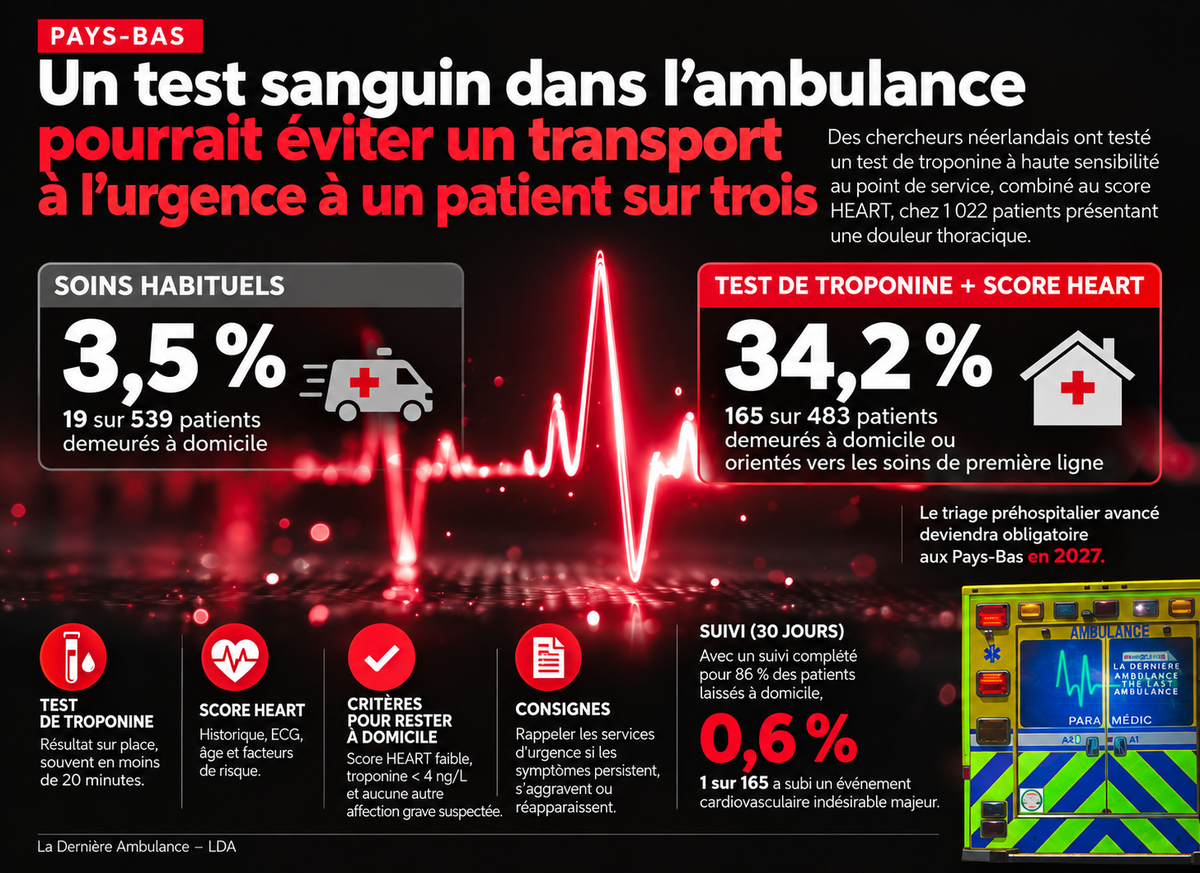
Le service ambulancier de Rotterdam-Rijnmond a étudié 1 022 patients présentant une douleur thoracique entre 2022 et 2025.
Avec les soins habituels, seulement 19 des 539 patients — 3,5 % — sont demeurés à domicile.
Après l’introduction d’un test sanguin de troponine à haute sensibilité effectué au point de service et combiné au score HEART, 165 des 483 patients — 34,2 % — sont demeurés à domicile ou ont été orientés vers les soins de première ligne plutôt que transportés à l’urgence.
Source : European Society for Emergency Medicine
La troponine est une protéine libérée dans le sang lorsque le muscle cardiaque est endommagé. Le test utilisé dans l’étude permettait d’obtenir un résultat sur place.
Les paramédics pouvaient ensuite combiner ce résultat aux antécédents du patient, à son ECG, à son âge et à ses facteurs de risque cardiovasculaire afin de calculer un score HEART.
Pour qu’un patient puisse demeurer à domicile, son score HEART devait être faible, son taux de troponine inférieur à 4 ng/L et aucune autre affection grave nécessitant une évaluation hospitalière — notamment une embolie pulmonaire, un pneumothorax ou une pancréatite — ne devait être soupçonnée.
Les patients qui demeuraient à domicile recevaient la consigne de rappeler les services d’urgence si leurs symptômes persistaient, s’aggravaient ou réapparaissaient.
Et les patients laissés à domicile?
C’est la question essentielle.
Avec un suivi complété pour 86 % de la population étudiée, un des 165 patients laissés à domicile après l’implantation du protocole — 0,6 % — a subi un événement cardiovasculaire indésirable majeur dans les 30 jours.
Les chercheurs reconnaissent certaines limites. Tous les patients admissibles n’ont pas été inclus et le groupe étudié après l’implantation comptait davantage de patients à faible risque que le groupe précédent.
Ils rapportent toutefois que l’ajustement pour cette différence n’a pas modifié de façon importante les résultats.
Les données demeurent préliminaires : elles ont été présentées dans le cadre d’un congrès et non dans une publication finale évaluée par les pairs.
Mais elles ne sont pas isolées.
Le programme de recherche néerlandais ARTICA avait déjà étudié l’utilisation préhospitalière du score HEART et de la troponine au point de service chez des patients considérés à faible risque d’infarctus du myocarde.
ARTICA rapporte que ces travaux ont contribué à une modification des soins standards aux Pays-Bas pour les patients à faible risque à compter du 1er janvier 2026. ARTICA-1
Une méta-analyse individuelle publiée ce mois-ci dans Heart a également examiné six études prospectives regroupant 5 239 patients.
Les auteurs concluent que des scores de risque clinique dérivés du HEART peuvent identifier des patients présentant un très faible risque de décès ou d’événement cardiaque indésirable majeur lorsqu’ils sont utilisés dans des systèmes préhospitaliers bien formés disposant d’un suivi fiable. Ils soulignent toutefois que leur implantation dans d’autres systèmes de santé nécessite une validation supplémentaire.
Étude publiée dans Heart — PubMed
Les Pays-Bas vont déjà plus loin.
La Dre Barbra Backus, qui a présenté les résultats de Rotterdam-Rijnmond, a indiqué au congrès que le triage préhospitalier avancé deviendra obligatoire aux Pays-Bas en 2027.
ARTICA-2, lancé ce mois-ci, examine maintenant une autre partie de la même question : déterminer si les paramédics peuvent utiliser la troponine à haute sensibilité et l’évaluation du risque pour diriger les patients à risque intermédiaire ou élevé directement vers l’hôpital le plus approprié, plutôt que systématiquement vers le plus proche. ARTICA-2
Le changement le plus important
La technologie est intéressante.
Mais l’évolution du rôle du paramédic l’est peut-être encore davantage.
Pendant des décennies, une grande partie des soins préhospitaliers s’est articulée autour d’une question fondamentale :
Est-ce que ce patient a besoin d’une ambulance?
Les travaux néerlandais posent de plus en plus une autre question :
Est-ce que ce patient a besoin d’un hôpital?
Et ils donnent aux paramédics les outils diagnostiques — ainsi que les trajectoires cliniques — qui pourraient leur permettre d’y répondre avant même que l’ambulance quitte les lieux.
Vous lisez La Dernière Ambulance. Pour ne rien manquer ...
26-09-2026 — INTERNATIONAL | NETHERLANDS
A blood test in the ambulance could keep one-third of chest-pain patients out of the ED
For a patient with chest pain, transport to an emergency department has long been the near-automatic pathway.
Researchers in the Netherlands are testing a very different model: give paramedics enough diagnostic information to determine, before leaving the patient's home, whether the patient actually needs a hospital.
Preliminary results presented at the European Emergency Medicine Congress suggest the change could be substantial.
The Rotterdam-Rijnmond ambulance service studied 1,022 patients with chest pain between 2022 and 2025.
Under usual care, just 19 of 539 patients — 3.5% — were left at home.
After crews began combining a high-sensitivity point-of-care troponin blood test with the HEART score, 165 of 483 patients — 34.2% — were left at home or referred to primary care instead of being transported to an emergency department.
Source: European Society for Emergency Medicine
Troponin is a protein released into the blood when heart muscle is damaged. The point-of-care test used in the study provided a result at the scene.
Paramedics could then combine that result with the patient's history, ECG, age and cardiovascular risk factors to calculate a HEART score.
For a patient to remain home, the HEART score had to be low, high-sensitivity troponin had to be below 4 ng/L, and crews could not suspect another serious condition requiring hospital assessment, such as pulmonary embolism, pneumothorax or pancreatitis.
Patients remaining home were instructed to call emergency services again if their symptoms persisted, worsened or returned.
What happened to the patients left at home?
That is the critical question.
With follow-up completed for 86% of the study population, one of the 165 patients left at home following implementation — 0.6% — experienced a major adverse cardiovascular event within 30 days.
The researchers acknowledge limitations. Not every eligible patient was included, and the group studied after implementation contained more low-risk patients than the earlier group.
They reported, however, that adjusting for that difference did not meaningfully change the results.
The findings remain preliminary. They were presented at a scientific congress rather than in a completed peer-reviewed publication.
But they are not appearing in isolation.
The Dutch ARTICA research program previously studied prehospital HEART-based assessment and point-of-care troponin in patients considered at low risk of myocardial infarction.
ARTICA reports that this evidence contributed to a change in standard Dutch care for low-risk patients beginning January 1, 2026. ARTICA-1
A separate individual-patient meta-analysis published this month in Heart examined six prospective studies involving 5,239 patients.
The authors concluded that HEART-derived clinical risk scores can identify patients at very low risk of death or a major adverse cardiac event when used in well-trained EMS systems with reliable follow-up. They cautioned, however, that implementation in other health systems requires additional validation.
The Netherlands is already moving further.
Dr. Barbra Backus, who presented the Rotterdam-Rijnmond findings, told the congress that advanced prehospital triage will become mandatory in the Netherlands in 2027.
ARTICA-2, launched this month, is examining another part of the same question: whether paramedics can use rapid high-sensitivity troponin testing and risk assessment to send intermediate- and high-risk patients directly to the most appropriate hospital, rather than automatically transporting them to the nearest one. ARTICA-2
The bigger change
The technology is interesting.
But the evolution of the paramedic's role may be even more important.
For decades, much of prehospital medicine has been built around a fundamental question:
Does this patient need an ambulance?
The Dutch work is increasingly asking a different one:
Does this patient need a hospital?
And it is giving paramedics the diagnostic tools — and clinical pathways — that may allow them to answer it before the ambulance ever leaves the scene.
You're reading The Last Ambulance. Don't miss a thing...