Et si on demandait aux données où devraient être nos ambulances?

(English version follows the French version).
Muskoka, ON — Il se passe quelque chose d'intéressant à Muskoka, en Ontario.
En 2025, Muskoka Paramedic Services a effectué 7 368 repositionnements d'ambulances — environ 20 par jour — afin de maintenir la couverture lorsque d'autres unités étaient occupées.
Mais le service reconnaît que son modèle statique de déploiement entraîne davantage de déplacements, de kilométrage et de consommation de carburant sans améliorer de façon fiable les temps de réponse.
Alors Muskoka a décidé de mettre son modèle à l'épreuve.
Des données opérationnelles anonymisées sont analysées avec Effective AI et Centennial College afin d'évaluer les pratiques actuelles et de modéliser d'autres scénarios de couverture.
Et les données montrent pourquoi la question mérite d'être posée.
En 2025, Muskoka a atteint tous ses objectifs officiels de temps de réponse. Mais la performance en arrêt cardiaque est passée de 36 % à 28 %, tandis que celle des cas CTAS 1 est passée de 54 % à 47 %.
Le service fait également face à d'importants délais hospitaliers : 48,4 % des patients transportés au South Muskoka Memorial Hospital et 44,4 % de ceux transportés au Huntsville District Memorial ont attendu plus de 30 minutes avant le transfert de responsabilité.
Le rapport résume remarquablement bien le problème :
« Au moment où l'appel est reçu, le temps de réponse est, dans les faits, déjà déterminé. »
Autrement dit, tout dépend largement d'où se trouve l'ambulance — et de sa disponibilité — avant même que l'appel entre.
Et Muskoka pousse maintenant l'analyse plus loin.
Le 20 août, le conseil a été appelé à autoriser le partage de données anonymisées avec Queen's University. Un employé du service qui y poursuit des études supérieures étudiera la croissance de la demande, l'impact du vieillissement de la population ainsi que le moment et l'endroit où surviennent les appels afin d'identifier les points de pression du système.
Pris ensemble, ces travaux posent trois questions très simples :
Où devraient être les ambulances?
Qu'est-ce qui détermine réellement leur temps de réponse?
Où sera la demande demain?
Et c'est là que Muskoka devient intéressant pour le Québec.
Combien de kilomètres nos ambulances parcourent-elles chaque année simplement pour maintenir la couverture?
Quels repositionnements améliorent réellement les temps de réponse?
Combien d'heures de disponibilité perdons-nous dans les urgences?
Et pouvons-nous démontrer, données à l'appui plutôt que par habitude institutionnelle, que nous plaçons les bonnes ressources aux bons endroits, aux bons moments?
Les données existent.
Ces questions n'ont rien de radical. Ce qui devient difficile à défendre, c'est de ne pas les poser.
There is something interesting happening at Muskoka Paramedic Services.
Over the course of six months, the Ontario service has produced a series of public documents that, taken together, reveal an unusually systematic attempt to answer some of the most fundamental questions facing an ambulance service:
Where should ambulances be positioned?
What is preventing them from being available?
How well is the system actually performing?
And where will demand come from in the years ahead?
The numbers provide a good reason to ask.
In 2025, Muskoka Paramedic Services carried out 7,368 stand-by movements — roughly 20 every day — repositioning ambulances to maintain geographic coverage as other units became committed.
But in a February report to elected officials, the service acknowledged something important about that longstanding approach.
Its deployment plan is essentially static and manually applied. And while moving ambulances around may create greater apparent geographic coverage, Muskoka says it also produces more vehicle movement, longer travel distances, additional mileage and fuel consumption “without reliably improving response times.”
Rather than simply accepting the model, Muskoka decided to test it.
The service sought authorization to share anonymized operational data with Effective AI, working with Centennial College's WIMTACH program. Historical and near-real-time information would be analyzed to identify inefficiencies, evaluate existing practices and model alternative coverage scenarios.
The initial analysis costs the municipality nothing. If the work ultimately demonstrates a case for implementing live predictive-deployment technology, that would come back separately through the 2027 budget and a formal procurement process.
Then came the response-time numbers
Two months later, Muskoka presented its 2025 response-time performance.
Every established target had technically been met.
But the underlying numbers were more complicated.
For sudden cardiac arrest, Muskoka's standard calls for someone capable of defibrillation to arrive within six minutes at least 25% of the time. Performance fell from 36% in 2024 to 28% in 2025.
For CTAS 1 patients, the target is an ambulance within eight minutes at least 45% of the time. Performance fell from 54% to 47%.
The report also identified a major constraint on ambulance availability: hospital offload.
Of 4,716 patients transported to South Muskoka Memorial Hospital during 2025, 48.4% experienced offload times exceeding 30 minutes. At Huntsville District Memorial Hospital, 44.4% of 2,934 patients did.
And buried in the analysis is perhaps the most important sentence in all three documents:
“By the time a call is received, the response time is effectively already determined.”
Muskoka's point is straightforward. How quickly an ambulance reaches the next patient depends heavily on where paramedics are and whether they are available at the moment the call arrives — conditions created by staffing, geography, call volume, seasonal demand and ambulances tied up at hospitals.
In other words, response time isn't merely a measure of how quickly an ambulance drives after somebody calls 911.
It is an outcome produced by the system that existed before the phone rang.
And now Muskoka is looking forward
On August 20, Muskoka District Council was asked to authorize another data-sharing agreement.
This one is with Queen's University.
A Muskoka Paramedic Services employee completing a graduate-level program at Queen's is undertaking a capstone research project examining response performance and future service demand.
The project will use anonymized operational data to examine three things:
- future ambulance demand based on population growth and changing call patterns;
- the effect of an aging population on transport demand;
- when and where calls occur, in order to identify existing pressure points.
Again, there is no direct additional cost to the municipality. Existing staff and systems will handle the data extraction.
Three questions. One system.
Taken separately, none of these initiatives is revolutionary.
Taken together, they're considerably more interesting.
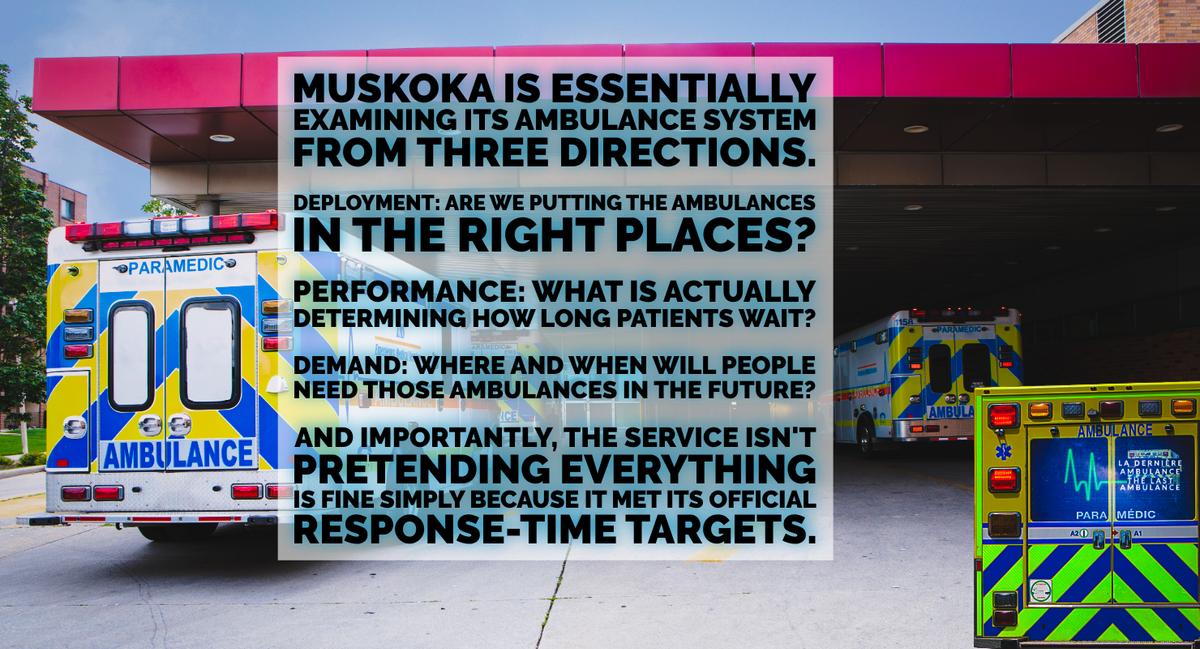
Muskoka is essentially examining its ambulance system from three directions.
Deployment: Are we putting the ambulances in the right places?
Performance: What is actually determining how long patients wait?
Demand: Where and when will people need those ambulances in the future?
And importantly, the service isn't pretending everything is fine simply because it met its official response-time targets.
It has publicly documented thousands of ambulance relocations. It has acknowledged that those movements don't reliably improve response times. It has quantified hospital offload delays. It has reported deteriorating performance in two of its most time-sensitive categories. And it is allowing outside researchers and analysts to interrogate anonymized operational data in search of better answers.
There is a lesson here that travels considerably farther than Muskoka.
The data exist
Ambulance services generate extraordinary amounts of operational information every day.
Every call has timestamps. Every ambulance has movements. Every deployment has consequences. Hospitals create measurable offload intervals. Demand varies geographically and temporally. Population change can be modelled. Deployment strategies can be tested against actual outcomes.
The question isn't whether modern ambulance systems possess enough data.
It's whether they're willing — and institutionally capable — of using those data to challenge the assumptions under which they operate.
For those of us watching Québec's prehospital system, that is what makes these otherwise rather dry municipal reports from Muskoka so interesting.
Because the obvious question isn't whether Québec should copy Muskoka's particular deployment model.
It's much simpler:
Could we conduct the same analysis here?
How many kilometres do Québec ambulances travel every year simply repositioning for coverage?
Which stand-by movements measurably improve response performance — and which don't?
How much ambulance availability is being consumed by hospital offload delay, by region and by hour?
Where will ambulance demand actually occur five or ten years from now?
And can we demonstrate, with data rather than institutional habit, that we're putting the right resources in the right places at the right times?
Those aren't particularly radical questions.
What's becoming harder to defend is not asking them.